Many people hear the word Takaful and immediately associate it with a form of financial protection aligned with Islamic finance principles. However, Takaful is not a single product.
It is a broader cooperative protection framework that can be adapted to the needs of individuals, families, and businesses.
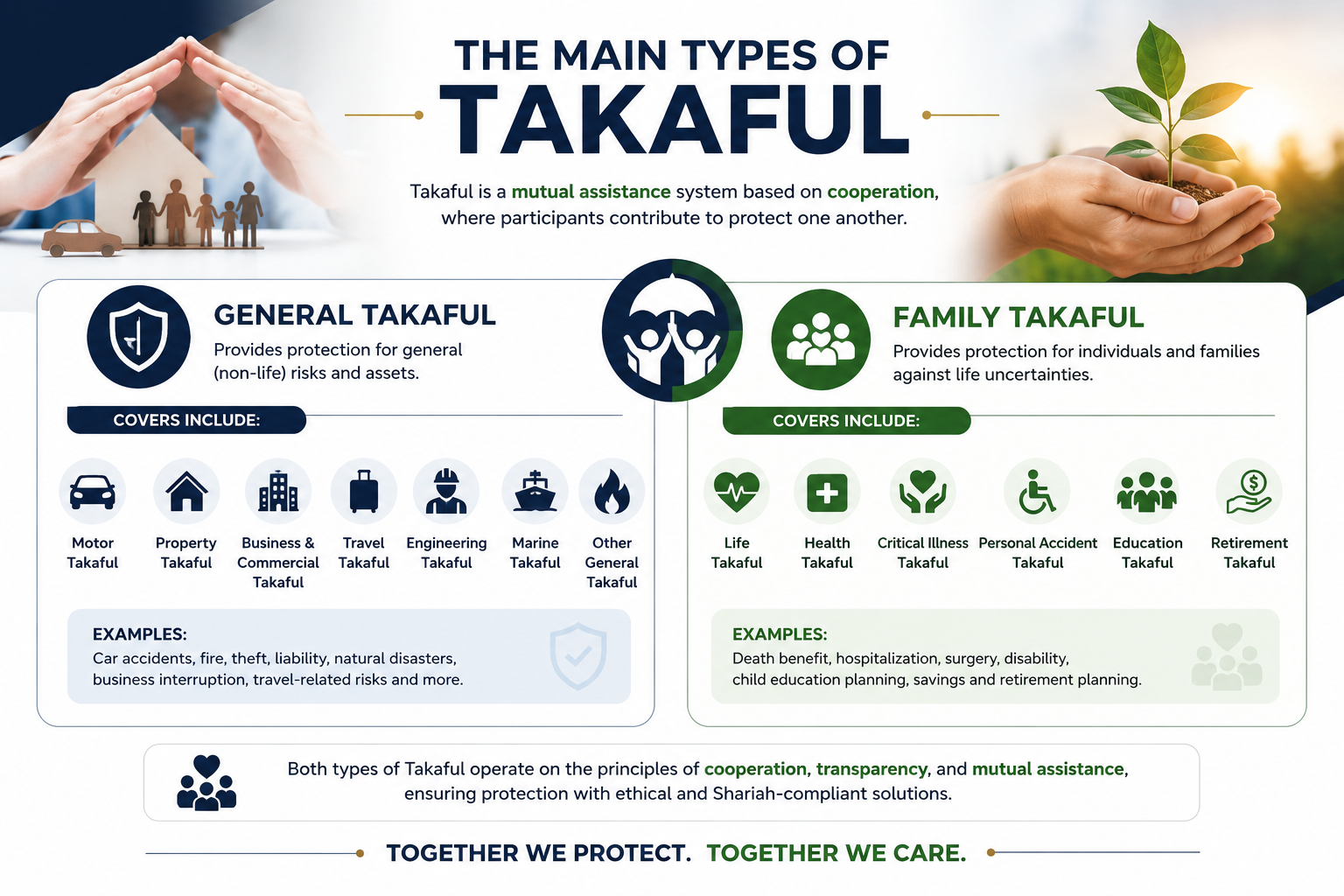
Internationally, Takaful is generally organized around two broad categories:
- General Takaful;
- Family Takaful.
Although these two categories address different needs, they can share common principles such as mutual assistance (Ta'awun), risk sharing, transparency, and, where an arrangement is represented as Shariah-compliant, appropriate governance.
What Is Takaful?
Takaful is a cooperative system of financial protection in which participants contribute to a common arrangement designed to support eligible members when covered losses occur.
In many models, a portion of participant contributions is allocated to a Participants' Risk Fund, which is used to support eligible claims and other permitted fund obligations.
The exact structure can vary depending on the jurisdiction, product, institutional model, insurer arrangement, and applicable regulation.
For a broader introduction, see our What Is Takaful? guide.
General Takaful
General Takaful generally focuses on protecting property, businesses, liabilities, vehicles, and other non-life risks.
Its purpose is to reduce the financial impact of covered events such as accidents, fire, theft, property damage, or business interruption, depending on the terms of the product.
Common General Takaful Categories
-
Motor Takaful
May provide protection for vehicles against risks such as collision, theft, fire, vandalism, and third-party liability, depending on the product and jurisdiction. -
Property Takaful
May protect homes, residential buildings, commercial properties, and their contents against covered risks. -
Business and Commercial Takaful
May be structured to address risks involving buildings, equipment, inventory, liability, and business operations. -
Travel Takaful
May include protection related to travel, such as eligible medical expenses, trip cancellation, lost baggage, or other covered travel events. -
Engineering Takaful
May cover certain risks involving construction projects, contractors, machinery, equipment, and engineering works. -
Marine Takaful
May protect ships, cargo, goods in transit, and other marine or logistics-related exposures. -
Other Specialized General Takaful Products
Depending on the market, General Takaful may also be adapted to other commercial or specialized risk categories.
Examples of Risks That May Fall Under General Takaful
- motor vehicle accidents;
- fire damage to a home or commercial property;
- theft of business equipment;
- business interruption following a covered event;
- marine cargo loss or damage;
- construction-site incidents.
Actual coverage always depends on the certificate or policy wording, exclusions, limits, deductibles, underwriting requirements, and other applicable conditions.
Family Takaful
Family Takaful generally focuses on the financial protection of individuals and families.
Depending on the market and product structure, it may combine protection features with savings or investment elements, subject to applicable regulatory and governance requirements.
While General Takaful is usually associated with property, liability, and business risks, Family Takaful is more closely associated with personal and family financial needs.
Common Family Takaful Categories
-
Family or Death Protection
May provide a financial benefit to eligible beneficiaries according to the terms of the certificate. -
Health Protection
May help cover certain eligible medical expenses depending on the product structure. -
Critical Illness Protection
May provide financial support when a covered serious illness is diagnosed. -
Personal Accident Protection
May provide benefits in cases involving accidental death, disability, or covered bodily injury. -
Education Planning
Some products may include a savings component designed to support future education expenses. -
Retirement and Long-Term Savings
Some Family Takaful structures may include long-term savings or investment components subject to the applicable Takaful model.
Examples of Potential Family Takaful Benefits
- benefits payable to eligible beneficiaries after a covered death;
- coverage for eligible hospitalization or medical expenses;
- financial support following a covered critical illness;
- disability-related benefits;
- education-related savings or funding;
- long-term savings or retirement planning.
The availability and structure of these products can vary significantly across countries, insurers, regulatory systems, and Takaful models.
What Do General Takaful and Family Takaful Have in Common?
Although they address different types of financial needs, both categories can operate within the same broader cooperative framework.
-
Mutual Assistance (Ta'awun)
Participants contribute to an arrangement designed to support eligible members when covered losses occur. -
Risk Sharing
The model seeks to organize risk pooling among participants according to the applicable Takaful structure. -
Transparency
Participants should be able to understand how contributions, fees, coverage, and fund rules are structured. -
Shariah Governance
Where an arrangement is represented as Shariah-compliant, appropriate governance should apply to relevant aspects of the model. -
Shariah-Compliant Investment
Funds associated with a Shariah-compliant Takaful arrangement are generally expected to follow an approved investment framework. -
Fairness and Accountability
The arrangement should be administered consistently and in accordance with contractual, regulatory, and governance requirements.
What Is the Main Difference Between General Takaful and Family Takaful?
The main difference is the type of need being addressed.
General Takaful is generally associated with property, vehicles, businesses, liability, and other non-life risks.
Family Takaful is generally associated with personal and family financial protection and, depending on the product, certain savings or investment objectives.
Why Is This Distinction Important?
Understanding the distinction helps individuals and businesses identify the type of protection that may best match their needs.
A business, for example, might seek General Takaful for property, equipment, or liability-related risks.
At the same time, individuals or families may be interested in Family Takaful for personal financial protection or longer-term financial planning, where such products are available in their jurisdiction.
Together, these two categories can address a wide range of financial protection needs within a cooperative framework.
The Role of the Participants' Risk Fund
In many Takaful models, the Participants' Risk Fund plays a central role.
A portion of participant contributions may be allocated to this fund to support eligible claims, reserves, and other permitted obligations.
The way the fund is managed, financed, and governed depends on the Takaful model, contract terms, insurer arrangements, and applicable regulation.
For a more detailed explanation, read our guide to Takaful fund management.
The Role of the Takaful Operator
The Takaful operator administers the arrangement under the chosen operating model.
Its responsibilities may include:
- administration;
- participant servicing;
- support for underwriting operations;
- claims coordination;
- technology and systems;
- reporting;
- compliance support;
- operational governance.
Under some models, the operator may receive a Wakalah fee or other contractually defined remuneration.
The Role of Shariah Governance
Where a Takaful arrangement is represented as Shariah-compliant, appropriate governance is important to support the integrity of that representation.
Relevant areas may include:
- contract structure;
- Tabarruʿ arrangements;
- operator fees;
- investment activities;
- Participants' Risk Fund management;
- surplus and deficit treatment;
- relevant operational practices.
Takaful in Canada
In Canada, any future Takaful solution must operate within the applicable insurance regulatory framework.
Product availability may depend on factors such as:
- participation by an authorized insurer;
- available insurance capacity;
- provincial regulatory requirements;
- underwriting;
- product approvals;
- distribution arrangements;
- applicable governance requirements.
The fact that a particular Takaful product exists in another country does not automatically mean that the same product is currently available in Canada.
For more Canadian context, see our Takaful Canada guide.
The Iman Risk Solutions Approach
At Iman Risk Solutions Inc., we are developing digital-first infrastructure intended to support transparent, ethical, and Takaful-aligned insurance distribution in Canada.
Our approach focuses on technology, education, broker relationships, insurer partnerships, regulatory preparation, and appropriate governance.
Iman Risk Solutions Inc. is currently in a pre-launch and development stage and is not currently offering, selling, binding, or underwriting insurance products.
Any future Takaful offering would remain subject to required licensing, insurer capacity, underwriting, product approval, regulatory requirements, and applicable governance.
Key Takeaways
General Takaful and Family Takaful address different financial needs but can share the same cooperative foundation.
- General Takaful generally focuses on property, vehicles, businesses, and liability-related risks.
- Family Takaful generally focuses on personal and family financial protection.
- Both categories can involve risk pooling, transparency, governance, and clearly defined fund-management rules.
- The exact structure always depends on the product, operator, insurer, jurisdiction, and regulatory framework.
Continue Learning About Takaful
Explore our Takaful Knowledge Hub, What Is Takaful? guide, How Takaful Works resource, and Takaful Canada guide for more information.
Important Notice: Iman Risk Solutions Inc. is currently in a pre-launch and development stage and is not a licensed insurer. This article is provided for educational and informational purposes only. It does not constitute insurance advice, an offer of insurance, confirmation of product availability, underwriting approval, confirmation of coverage, or binding authority.
Continue Learning
Explore related Iman Risk Solutions pillar pages and structured resources.
Takaful in Canada Start with the principal Canadian guide to Takaful, governance, contributions, and regulation. Takaful Resources Browse structured learning paths covering Takaful fundamentals, funds, governance, and distribution. Islamic Insurance Canada Explore Islamic insurance terminology, Shariah governance, and the Canadian context. Takaful for Brokers Canada Learn about future broker distribution, training, compliance, and digital workflows.Discussion
No comments yet. Be the first to share your perspective.
Join the Conversation
Related Articles
What is Takaful? A Complete Guide for Canadian Muslims (2026)
Discover how Takaful (Islamic cooperative insurance) works, why it's Shariah-compliant, and when it will be available in Canada. …
Comment fonctionne une soumission Takaful ? Transparence, équité et clarté à chaque étape
Une soumission Takaful ne devrait pas se limiter à afficher un montant total. Découvrez comment une soumission transparente …
How Takaful Quotes Work: Transparency, Fairness, and No Hidden Fees
Discover how Takaful insurance quotes are built differently — with full transparency, cooperative principles, and no hidden costs. …
Les principaux types de Takaful : comprendre le Takaful Général et le Takaful Familial
Saviez-vous que le Takaful se divise en deux grandes catégories ? Découvrez les différences entre le Takaful Général …
Pourquoi un assureur agréé choisirait-il de s'associer à un MGA Takaful ? Comprendre la véritable proposition de valeur
Si les assureurs conventionnels comptent déjà des clients musulmans parmi leur clientèle, pourquoi s'associer à un Managing General …
Why Would a Licensed Insurer Partner with a Takaful MGA? Understanding the Real Value Proposition
If conventional insurers already have Muslim customers, why would they partner with a Takaful Managing General Agency (MGA)? …